

Venture Debt Review 2025-2026
In partnership with

Table of Contents
1. Executive Summary
2. The Great Venture Bifurcation:
AI Versus Everything Else
3. Venture Debt: From Supplement to Structural Capital
4. A Maturing Market: Repeat Borrowing and Structural Discipline
5. Sector Dynamics: Growth, But Not Uniformly Distributed
6. Beyond SaaS: The Expansion of Underwritable Models
7. Exits: Liquidity Returns, and Debt-Backed Companies Participate
8. Conclusion and Outlook

1. Executive Summary
The 2025 venture capital (equity) market was defined by extreme concentration in AI alongside a broader reset toward discipline. U.S. VC investment reached $321.6 billion across more than 17,000 deals, but half of all capital flowed into just 0.05% of transactions, with AI accounting for 63.5% of deal value. Outside of AI, capital is being deployed more selectively, with greater focus on fundamentals, financial performance, and path to profitability.
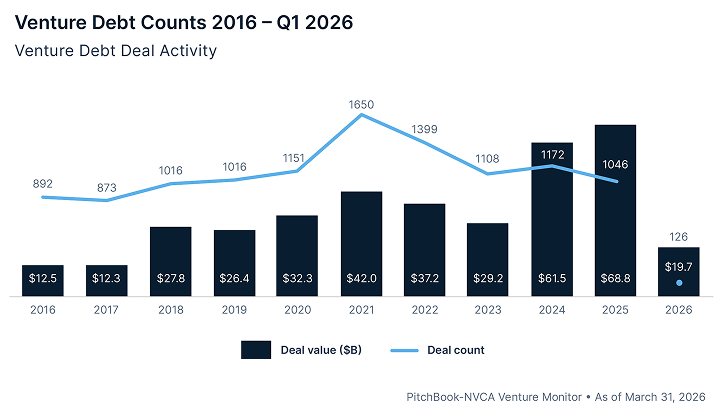
Venture debt reached a record $68.8 billion in 2025 and has become a structural pillar of the venture ecosystem. Deal volume remained stable at around 1,000 transactions annually, signaling durable, ecosystem-wide adoption.
The venture debt market is scaling and institutionalizing, driven by larger, repeat, and more structured financings. Deal sizes rose across the distribution, and follow-on financings increased as borrowers and lenders build multi-facility relationships, supported by a deeper base of lenders (banks, private credit funds, and specialist lenders). Early-stage activity has also rebounded to over $15 billion, though the market is still driven primarily by larger, later-stage borrowers.
Venture debt is expanding beyond SaaS into a wider range of sectors and business models. While AI and SaaS still anchor activity, growth in healthtech, cleantech, and asset- or IP-heavy companies show the ability to tailor debt to contracted revenue, assets, and sector-specific structures.
Improving exit markets are reinforcing venture debt’s role in supporting outcomes and capital efficiency. In 2025, exits reached $286.9 billion in value, with venture debt-backed companies accounting for 37% of exit value and 18% of exit count (based on actual counted exits), both increases from the prior year.
2. The Great Venture Bifurcation: AI Versus Everything Else
At $321.6 billion, U.S. venture investment in 2025 marked the second-highest total on record. More than 17,000 deals were completed, signaling a recovery from the 2023–2024 slowdown.
But headline strength obscures a defining reality. Venture capital has become highly concentrated. Roughly half of all dollars flowed into just 0.05% of transactions, with AI accounting for 63.5% of deal value and over 40% of deal count. Capital continues to cluster around a small number of category leaders, particularly in foundation models and AI infrastructure.
This concentration matters. Capital is abundant at the top of the market, but the broader ecosystem is operating with more caution. Outside of AI, venture capital has largely normalized from the excesses of 2021. Early-stage activity has rebounded toward prior highs, signaling continued company formation, but with greater selectivity and scrutiny around fundamentals. At the same time, conditions for more mature, later-stage companies are increasingly shaped by institutional capital, with financing tied more directly to revenue predictability, operating performance, and proximity to profitability.
The implication is clear. The real signal in today’s market is not AI exuberance, but the health and discipline of the broader ecosystem. That environment has created fertile ground for venture debt to scale, particularly for companies with durable revenue, capital efficiency, and structures that support underwriting.

3. Venture Debt: From Supplement to Structural Capital
Venture debt reached a record $68.8 billion in the U.S. in 2025, while annual deal volume stabilized at roughly 1,000 transactions. Rising dollars with steady deal count signals a market that is scaling, not overheating.
Growth is driven by larger and repeat financings rather than a broad expansion in borrower count. Even as availability expands earlier in the lifecycle, access remains selective and tied to fundamentals that can be reliably underwritten, with the greatest benefits accruing to higher-quality companies.
More importantly, venture debt is no longer episodic. It is becoming embedded in capital planning, particularly among later-stage and scaled borrowers with greater operating visibility that view debt as a strategic financing tool rather than a situational source of liquidity. These companies are using debt alongside equity as part of a deliberate financing strategy rather than as a last-mile extension of runway.
Deal size trends reinforce this shift. The 75th percentile rose to $27.7 million in 2025, the median increased to $5.5 million, and the lower quartile also reached new highs. While averages are skewed by a small number of large financings, the upward movement across the distribution points to broad adoption.
“Used from a position of strength, debt can be a highly rational tool for extending runway, preserving ownership and reaching a value-creating milestone. Used from a position of weakness, it can add complexity. The distinction comes down to whether the company is using debt to amplify momentum or to mask the absence of it.”
— STEVE BROTMAN, FOUNDER AND MANAGING PARTNER, ALPHA PARTNERS
Early-stage venture debt rebounded to just over $15 billion, reflecting measured expansion rather than a shift in the market’s center of gravity. Lenders are underwriting earlier-stage companies more precisely where revenue visibility, capital efficiency, or contractual structures support credit. The core of the market remains anchored in larger, later-stage borrowers that support repeat financings (and demand bigger deals).
This evolution is changing the financing playbook. Debt is increasingly available earlier, but only against specific attributes such as revenue quality, margin profile, customer retention, or contracted cash flows. Companies that demonstrate these characteristics can access nondilutive capital sooner and on better terms.
4. A Maturing Market: Repeat Borrowing and Structural Discipline
One of the clearest indicators of market maturity is the rise of follow-on financings. Venture investment subsequent to a venture debt round increased from $4.7 billion across 129 deals in 2024 to $12.3 billion across 156 deals in 2025.
This reflects a growing installed base of borrowers and a shift toward multi-facility relationships between companies and lenders. Venture debt is increasingly recurring and used across multiple stages rather than as a one-time bridge.
Deal structures are also evolving. In some parts of the market, lenders are placing greater emphasis on pricing risk directly into credit terms through rates, covenants, and structure, though many late-stage and growth facilities still include a structured component.
The expansion of the lender base is driving this change. Banks, private credit funds, and specialist lenders are scaling their presence, increasing competition and capital availability.
The trade-offs are becoming clearer. Greater competition can improve pricing and reduce dilution from warrants or equity participation, though these benefits remain concentrated among companies with stronger fundamentals and clearer visibility. At the same time, repeat access raises the bar. Lenders expect performance, and capital is allocated to companies that can demonstrate it. Used well, debt enhances flexibility and capital efficiency, but it does not replace fundamentals. It amplifies them.
Companies that use debt effectively tend to pair it with clear operating momentum. Where fundamentals are less certain, debt can add complexity to capital structure and future financing decisions.

5. Sector Dynamics: Growth, But Not Uniformly Distributed
Sector data reinforces that venture debt is expanding, but not evenly. AI and SaaS continue to dominate activity by both deal count and value, with SaaS alone exceeding $28 billion in financing for the second consecutive year.
Healthtech and cleantech posted strong year-over-year growth. However, much of that increase was driven by a small number of large, structured financings rather than a broad shift across those sectors.
This distinction is important. Headline growth can obscure the reality that venture debt remains highly selective. The market is not repricing risk uniformly. It is allocating larger pools of capital to companies with characteristics that support reliable underwriting.
Those characteristics are becoming more diverse. In climate and cleantech, contracted revenue models and asset-backed structures are increasing compatibility with debt. In healthtech, scale and recurring usage patterns support larger facilities.
Sector alone is no longer the primary determinant of access to debt. What matters is whether the business can be underwritten through revenue visibility, asset backing, or contractual cash flows. Companies that meet these criteria are accessing larger and more flexible credit solutions.
“More business models are becoming financeable as lenders get better at underwriting nontraditional indicators of quality, including Robotics-as-a-Service contracts, equipment-backed structures, and contracted revenue streams. Venture debt can play an important role in helping build the next generation of industrial and healthcare infrastructure.”
— LISA CHAI, GENERAL PARTNER, INTERWOVEN VENTURES
6. Beyond SaaS: The Expansion of Underwritable Models
Recent financings highlight how venture debt is extending beyond traditional recurring-revenue software businesses.
Anthropic’s approximately $2.5 billion revolving credit facility represents the outer edge of the market and is not broadly representative. It illustrates how large-scale credit can be extended to capital-intensive AI companies when supported by strategic importance, counterparties, and expected cash flow. More typical examples are emerging in sectors such as energy and healthtech, where debt is structured around contracted revenue or recurring usage.
Palmetto’s $1.2 billion in capital commitments for residential solar leases demonstrates a different model. Debt is structured around long-term customer contracts and asset-backed cash flows, closer to project finance than traditional venture lending.
In healthtech, companies like Spruce are securing multi-tranche facilities tied to recurring revenue and network scale, often with drawdowns linked to operational milestones.
The common thread is not sector. It is underwritability. Venture debt is expanding where lenders can anchor risk to durable sources of value.
This shift is expanding the range of companies that can access venture debt, but selectively, where lenders can underwrite against durable operating or contractual foundations. Companies that historically may not have qualified can access tailored structures when their models support clear and reliable underwriting. These structures are more bespoke and require clearer articulation of how value converts to cash flow.
7. Exits: Liquidity Returns, and Debt-Backed Companies Participate

Exit activity rebounded in 2025, with 1,514 actual counted exits generating $286.9 billion in value, the strongest environment in several years.
Venture debt-backed companies participated disproportionately, accounting for 37% of total exit value and 18% of exit count, both increases from the prior year.
At the same time, the venture ecosystem still faces a backlog of unrealized value, with over $1 trillion remaining across private portfolios and many unicorns yet to raise fresh capital since 2022.
Time-to-exit dynamics remain elevated overall. PitchBook measures median time from founding to exit, and debt-backed companies continue to show longer median durations than non-debt-backed peers – a reflection of the profile of companies that use debt rather than a disadvantage of debt itself.
Debt can accelerate outcomes when paired with strong execution. It provides flexibility and supports growth, while aligning capital with performance.
“Companies that use venture debt effectively are often the ones that reach an exit with greater strategic flexibility, stronger reporting discipline, and a cleaner path to the next stage of the company’s life cycle. Debt alone does not create successful outcomes, but over time, the operational rigor it demands can leave companies better prepared for the scrutiny, governance, and execution required in an exit.”
— TROY ZANDER, PARTNER, MANATT, PHELPS & PHILLIPS
8. Conclusion and Outlook
Venture debt has moved from the margins of the venture ecosystem toward its core. It is larger, more embedded, and more strategically deployed than at any point in its history.
This evolution is occurring alongside a venture market that is increasingly uneven. AI continues to attract outsized capital and attention, while the broader ecosystem operates with greater discipline. In that environment, venture debt is supporting companies outside the most concentrated equity segments, particularly those with predictable or contracted revenue, capital efficiency, and structures that can be reliably underwritten.
Looking ahead to 2026, this dynamic is likely to persist. Equity markets may remain concentrated, but debt markets are expanding in scale and applicability, while remaining selective and unevenly distributed across borrower types, and anchored in underwriting rather than narrative.
The message is clear. Access to venture debt is improving, but it is not indiscriminate. Capital is increasingly available to companies that can demonstrate revenue quality, capital efficiency, and clear paths to cash flow. Those that meet this bar can use debt to scale efficiently and preserve ownership. Others will find the market more selective.
In a venture environment defined by divergence, venture debt is emerging as both a source of discipline and a strategic advantage.
“Venture debt has moved decisively from the margins to the core of the venture financing toolkit. In a market defined by concentration at the top and discipline everywhere else, the companies that win in 2026 will be the ones who treat capital structure as a strategic choice — not a default. Debt, used well, is no longer a sign of distress. It is a sign of discipline, and increasingly, of competitive advantage.”
— DAVID SPRENG, FOUNDER AND CEO, RUNWAY GROWTH CAPITAL
