

A Founder’s Guide to Venture Debt

1. Introduction
For many startups, late-stage and growth-stage companies, access to capital is a primary concern. Entrepreneurs must be able to adapt to quickly changing market conditions and ensure their business is adequately funded to maintain operations and fuel growth. While there are a number of different financing options to consider, it’s important to know which is the best for your company. Many founders inherently seek equity funding, however, venture debt has become an increasingly popular financing option – especially among rapidly growing businesses.
What is venture debt?
Venture debt is a form of minimally dilutive funding for high-growth venture-backed companies.
Typically structured as a three-to-five year term loan,
proceeds are used to fund working capital, growth initiatives, acquisitions, or refinance existing debt. It can be a replacement for or a complement to equity financing. When utilized properly, venture debt can help a business grow without its founders having to incur unnecessary dilution nor give away control of their company. And unlike traditional bank lending, it is available to businesses that do not have positive cash flows or significant assets to use as collateral.
What are the primary use cases?
- Fuel growth initiatives such as sales and marketing, product development, and/or business expansion.
- Extend cash runway to reach the next company milestone (and increase valuation ahead of the next equity raise).
- Prevent a bridge round by borrowing between equity rounds.
- Fund a large capital expenditure such as the purchase of equipment or an acquisition.
- As an insurance policy to protect against unexpected business challenges or an economic downturn.
- Refinance existing lenders that may be unable to scale or unwilling to take the time to understand your business.
2. The Benefits For Borrowers
1. Debt is cheaper than equity
Debt financing allows a company to raise capital without its founders, management and early investors having to incur unnecessary equity dilution. If your business is successful (and growing), the value of that equity in the long run will likely far surpass the amount you would have paid with debt financing. In other words, the more profitable a company is or will be, the more costly it is to sacrifice equity. This makes debt a much lower cost of capital compared to equity financing, especially for high-growth companies.
2. Maintain control of your business
In many cases, equity financing requires giving up a seat on your board. This means there will be more opinions on how the business should be run. If you’ve been through multiple equity rounds and have added several new board members, you may no longer be the controlling voice. If you disagree with the approach of your fellow board members, they can overrule you and in extreme cases, oust you from your own company.
On the flip side, most venture debt lenders do not require a seat on the board. They generally don’t get too involved in your business, as long as you’re making on-time payments and meeting pre-agreed upon performance metrics.
3. Quicker access to capital
Raising equity financing can be time-consuming and cumbersome. Depending on the company, it can take 6 to 9 months or more. However, raising debt financing can be done in as little as 4-6 weeks. The benefit here is not only quicker access to capital, but more time for you to spend where it matters most – growing your business. Debt saves you time both at the onset and throughout the duration of the loan.

Venture debt vs. venture capital

3. When To Use Venture Debt
- Alongside an equity round.
- Between equity rounds (to prevent a bridge round), or to allow more time for progress to drive a higher equity valuation.
- When you don’t need it (as an insurance policy).
Venture debt should not be used if…
- The company is on a downward or unpredictable trajectory (i.e. high burn rate, highly variable revenue stream, or revenue has stalled or declined)
- The use of the loan is unclear
- The business is shifting or pivoting its strategy
- Debt is being considered as a last resort for financing
4. Common Misconceptions
While most founders claim to be comfortable using venture debt, they often do not understand when, how, and why it should be used.
Many view venture lending as an approach for early-stage startups, that it is risky, or a tool that’s used only when equity isn’t an option – rather than a complement to their capitalization strategy. The truth is the exact opposite. The companies that raise debt are those that can raise equity but choose not to because they want to avoid dilution.
These widespread misconceptions among founders highlight the need for further education.
5. Bank Lending vs. Non-Bank Lending
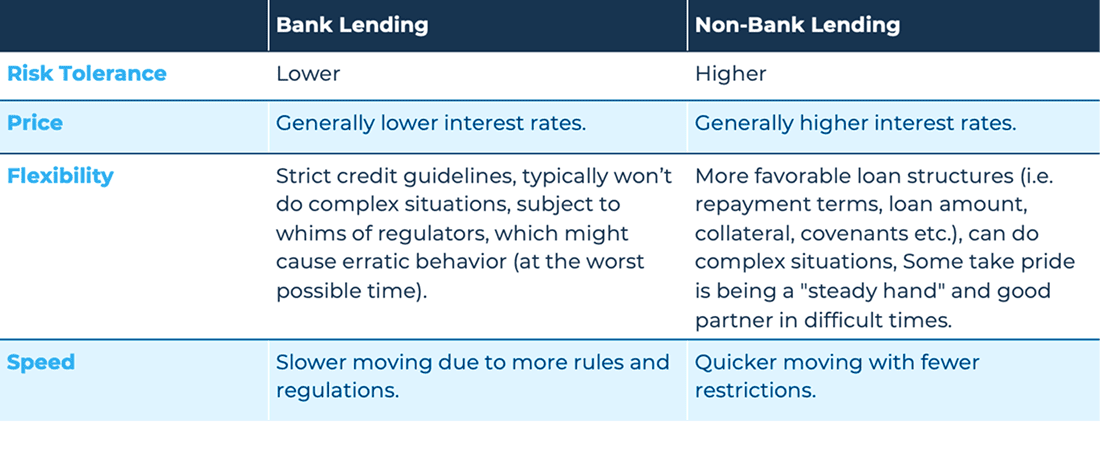
Once you’ve decided venture debt is right for your business there are generally two types of lenders to choose from: (1) venture banks and (2) specialty finance or non-bank lenders. While they may sound similar, there are some key differences.
Venture banks must adhere to specific regulations put in place by organizations such as the Federal Deposit Insurance Corporation (FDIC). These rules are designed to help protect depositors and monitor bank activity. As a result, banks have more strict credit guidelines, lower risk tolerances, and tend to be slower moving – but because of their more cautious approach, banks can lend money at lower interest rates.
On the flip side, non-bank / specialty finance lenders have a higher risk tolerance, enabling them to offer larger dollar amounts and more favorable loan structures (e.g. repayment terms, size of loan, collateral, covenants, etc.) than venture banks – albeit, at higher interest rates.
6. What to look for when choosing a lender
As an entrepreneur, you should be evaluating a lender on several factors: pricing, terms, covenants, industry knowledge, experience, reputation, breadth of network – as well as personality and demeanor. Are they partner-minded or purely transactional?
You’ll want a lender that is patient and understanding, not someone who is going to overreact at a slight bump in the road. While a lender may not be as directly involved in your business as a VC would, experienced lenders can be a valuable source of advice and bring a helpful network.
What do we look for in a potential borrower?
We lend to high-growth companies in technology, life sciences, and consumer industries. We seek passionate and driven management teams who need our capital to grow – whether that’s market share, revenue, profitability, production, or capacity.
We typically look for companies with…
- $10mm+ annual revenue
- 15-20%+ annual growth
- Meaningful IP or soft assets
- Proven product/market fit
- Pivots, turnarounds, and recaps okay
We back companies with strong intellectual property behind their products and services – we can lend where banks can’t, and unlike equity, we are minimally-dilutive capital – enabling financial backers, founders, and management teams to own more of their own companies.

7. Disclosures
Views and opinions expressed are for informational purposes only and do not constitute a recommendation by Runway Growth Capital to buy, sell, or hold any security. Views and opinions should not be construed as investment advice.
This material does not constitute an offer or solicitation in any jurisdiction where or to any person to whom it would be unauthorized or unlawful to do so.
Prospective investors should inform themselves as to any applicable legal requirements and taxation and exchange control regulations in the countries of their citizenship, residence or domicile which might be relevant. This material is provided for informational purposes only and should not be construed as investment advice or an offer or solicitation to buy or sell securities.
This material is not intended to be used as a general guide to investing, or as a source of any specific investment recommendations, and makes no implied or express recommendations concerning the manner in which any client’s account should or would be handled, as appropriate investment strategies depend upon the client’s investment objectives.
Although certain information has been obtained from sources believed to be reliable, we do not guarantee its accuracy, completeness or fairness. We have relied upon and assumed without independent verification, the accuracy and completeness of all information available from public sources.
Forward-looking statements: Certain information contained herein constitutes “forward-looking statements,” which can be identified by the use of forward-looking terminology such as “may,” “will,” “should,” “expect,” “anticipate,” “project,” “estimate,” “intend,” “continue,” or “believe,” or the negatives thereof or other variations thereon or comparable terminology. Due to various risks and uncertainties, actual events, results or actual performance may differ materially from those reflected or contemplated in such forward-looking statements. Nothing contained herein may be relied upon as a guarantee, promise, assurance or a representation as to the future.
